


It is driven by dual cores of scene experience and digital perception, takes visual art and spatial creation as research clues, and uses innovative methods of design engineering systems as the singularity of change. Exploring multi-dimensional industrial equipment innovation from short-distance transportation to public transportation, from smart equipment to smart cities and even ocean strategies is a design practice to cope with the changes in future mobility scene flows and transportation attributes.
With the mission of solving the natural and harmonious interaction between intelligent hardware products and people, it is oriented to the design research and innovation of typical intelligent interaction scenarios. Combining cross-disciplinary innovation methods and technologies such as computer technology, mechanical engineering, electronic technology, design management, and business models, we focus on the perception and experience of human-centered intelligent interactive aesthetics, and explore the birth and growth of new intelligent species integrating software and hardware.
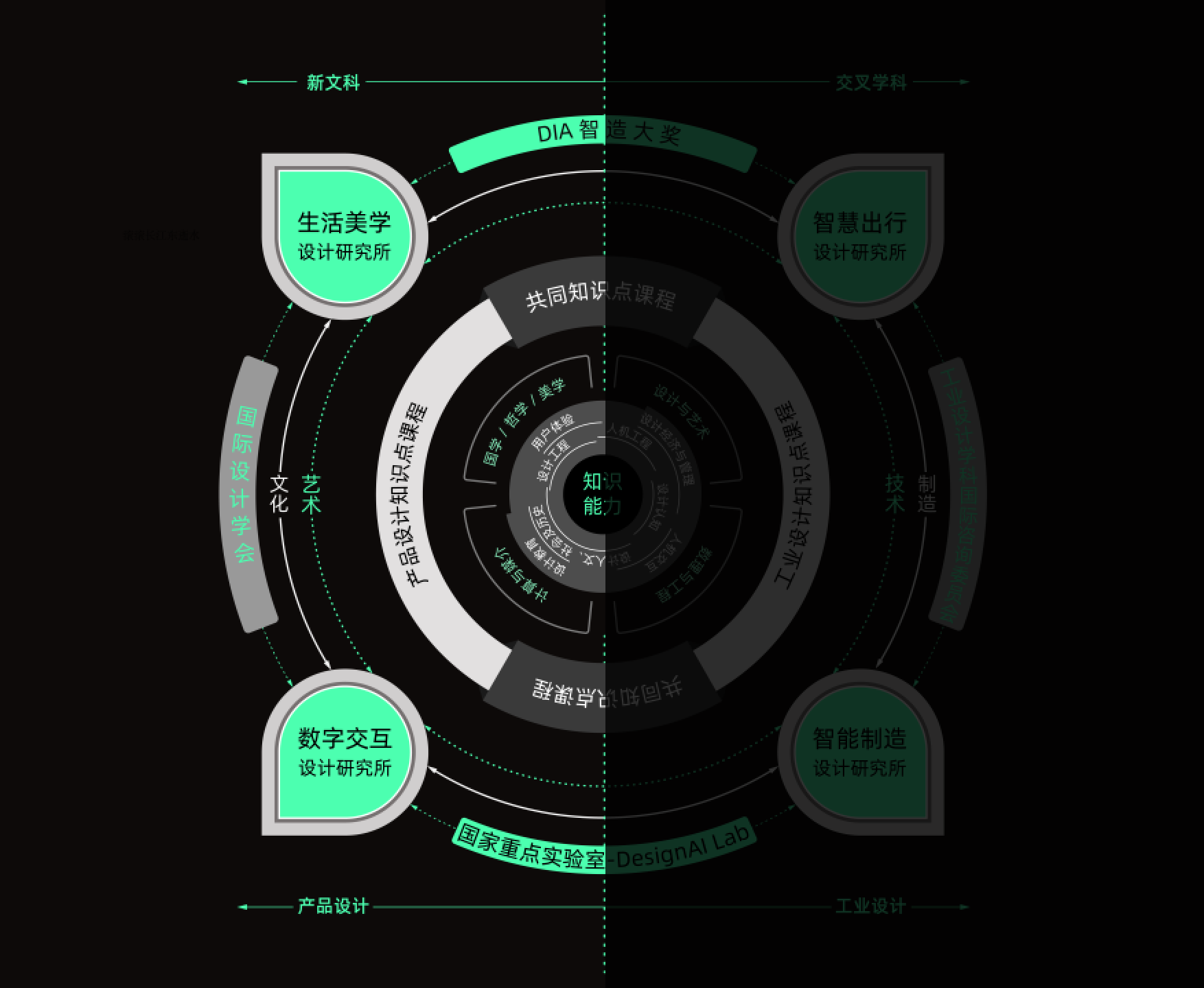
Guided by humanistic intelligence, with lifestyle as the core and user research as the basis, we explore creative patterns that reflect Chinese cultural values. The institute mainly focuses on creative practice in the fields of daily necessities, home appliances, health and entertainment, cultural tourism and social innovation, and combines interdisciplinary innovation methods and technologies such as digitalization, sensibility engineering, mechatronics, art and business management. Reflecting design ideas such as cultural aesthetics, ecological sustainability, and emotional care. It aims to re-invent daily life in the information age and cultivate independent designers with authorship for the forefront of the industry.
Digital interactive product design focuses on the digital transformation of society and industry. It takes intelligent software and hardware systems as the main design objects and explores the value flow and system ecology between people, information and society, aiming to create new business value and social significance. This professional direction includes but is not limited to single-dimensional design output such as product design, interaction design, interface design, and user research. Instead, it starts from a people-oriented perspective and integrates resources and system elements in design, business, technology and other fields to conduct overall proposals and full-link design. In the context of the digital economy, this direction will mainly focus on digital intelligent systems and services in industries such as consumer electronics, culture and education, and general health.
China Academy of Art (Liangzhu Campus)
China, Zhejiang Province, Hangzhou City, Yuhang District
No. 2849 Gudun Road
*11 Building No.
SID@caa.edu.cn
0000-12345678
