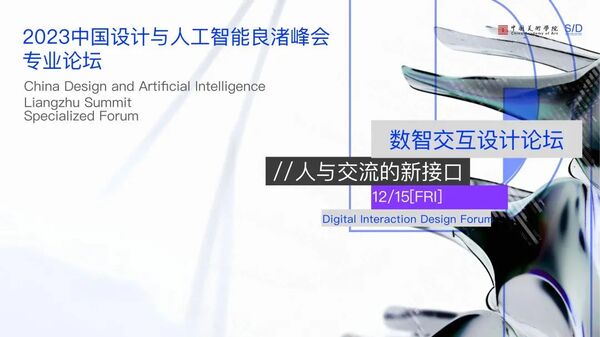
12 On March 15, the 2023 China Design and Artificial Intelligence Liangzhu Summit Digital Intelligence Interaction Professional Forum was successfully held at the Liangzhu Campus of the China Academy of Art. The forum meeting was chaired by Wu Peiping, associate professor of the School of Industrial Design of the China Academy of Art, and Li Yong, dean of the Graduate School of Guangzhou Academy of Fine Arts and dean of the School of Industrial Design. 30 scholars, experts and guests from various universities and industries gathered in Liangzhu to discuss the theme of "New Interface between People and Communication" AI relationships with people, discussing possible future communication methods and interfaces from different perspectives and forms, and opening up the field of digital intelligence interaction.

Panorama of the venue


Zhang Li pointed out that in design practices that are highly related to emerging technologies such as artificial intelligence, there have also been multiple updates in the way people communicate with the world. In a posthuman era that calls for transcending anthropocentrism, design can and should include nonhuman agency. With "mutuality"” (inter-objeotivity) to replace “intersubjectivity”” (inter-subjectivity) It is helpful for us to change a perspective and examine and understand the "introverted" communication method between objects and its alternative meaning-generating mechanism from a "object-oriented" rather than "human-oriented" standpoint. It is not only conducive to expanding the understanding of human nature, but also delaying the potential of design.

Zhang Li, professor, deputy dean and master tutor of the School of Design, Guangdong University of Technology

Hu Fei proposed a development logic based on agricultural economy - industrial economy - service economy - experience economy - transformation economy - digital economy, and discussed the connection, difference and transformation path between service design and experience design.
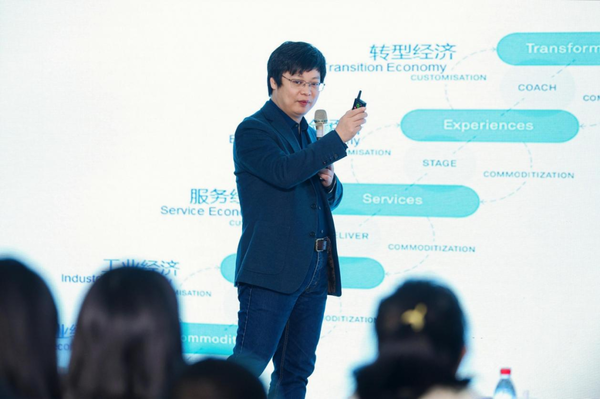
Hu Fei, long-term distinguished professor of Tongji University, dean of the School of Design and Innovation, and doctoral supervisor

From the perspective of science and technology ethics and science and technology aesthetics, Qin Jingyan discussed the dos and don’ts of technologies such as artificial intelligence, big data, and the virtual reality metaverse, and proposed seven core innovative design missions under the construction of digital ecological civilization, including 17 new goals for the sustainable development of digital ecological civilization under smart digital economy, smart living culture, smart life forms, smart production methods, and smart ecological civilization, as well as the corresponding sustainable meta-design methods.

Qin Jingyan, deputy dean of the School of Intelligent Science and Technology and director of the Science and Technology Aesthetic Education Center of the University of Science and Technology Beijing

In this report, Li Taihao will briefly introduce the development history of affective computing, the latest progress in multi-modal emotion data construction and multi-modal emotion recognition methods. In addition, the team's latest achievements in building multi-modal human interaction systems will also be presented.

Li Taihao, Deputy Director of Zhijiang Lab Artificial Intelligence Research Institute and Cross-Media Intelligence Research Center

Wang Guanyun proposed that through personalized manufacturing, flexible electronics, 4 D Printing and other technologies, focusing on exploring the design space and application fields of intelligent deformation materials. Research results have been applied in clothing, medical, food, agriculture and other fields.

Wang Guanyun, researcher and doctoral supervisor at Zhejiang University

Zeng Ping discussed Al The main body of development is alphabet logic, and the starting point is still Western "phonocentrism" and a "natural language processing" system based on English, without taking into account the needs of Chinese writing. Discuss from the perspective of a type design practitioner A! The essential difference between generative and written design rises.

Zeng Ping, a 2022 doctoral student in design at the China Academy of Art

Mr. Fu Jiqing from the Institute of Digital Intelligence Interaction of the China Academy of Art presided over the morning roundtable meeting. The meeting was themed "The Relationship between Digital Intelligence Interaction and Humanities" and raised the following three questions:
1: What impact has the rapid development of artificial intelligence had on the evolution of humans' role in society? What disruptive innovative changes will the digital interaction field under the development of artificial intelligence bring to the current society? Fu Jiqing, deputy director of the Institute of Digital Intelligence Interaction at the China Academy of Art, asked a question
2:“ "Digital Humanities" is an emerging, cross-cutting discipline and a transformation of the new paradigm of knowledge production triggered by media changes. So how do we face the changes in social civilization brought about by the opportunities of this transformation?
3:“ "Digital contact" allows individuals in different spaces around the world to "cloud presence" together. Virtual simulation and intelligent technology have improved the individual experience of digital communication. How to maximize the design value generated by industrial design in the process of upgrading humanistic exchanges to systematization and value?
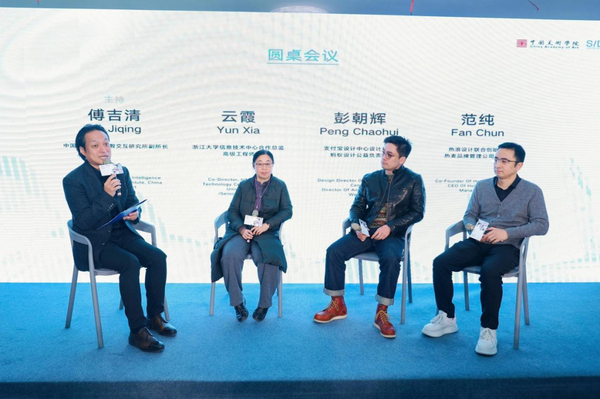
Roundtable meeting
Yun Xia, cooperation director and senior engineer of the Information Technology Center of Zhejiang University, believes that in the education and teaching system, it must first be brought online. After having the data, some guidance can be provided in the system to transform it into a model. For digital humanities, we now have a large number of knowledge bases, and the expert’s knowledge system is the most important. AI So far it is still difficult to understand, AI It is still unable to create truth, goodness and beauty. Currently we are also doing AIGC Experiment with children and parents, and we cannot let technology dominate our world; Peng Chaohui, design director of Alipay Design Center and head of Ant Design Charity, asked whether humans will be AI Instead, what are human beings? AI The owner should still develop it himself. AI For the humanities, information becomes simpler and simpler, and the sorting of information in the future is left to Ai, Human beings play a decision-making role, and they are worried about whether information will become a kind of "fast food" if it becomes convenient and simple and lacks the intermediate exploration process. He also proposed that virtuality and reality coexist. In the past few years, the development of the Metaverse was due to the mismatch between technology and hardware. Now there are AIGC A whole new time can be constructed. Future digital virtualization, such as blockchain for value certification, today's technology is at a crossroads, and future entertainment, television, etc. can be experienced in the cloud ; Co-founder of Relang Design, Remai Brand Management Company CEO Fan Chun said AIGC For e-commerce, it is very efficient. The selling points of products can quickly reach consumers. Information technology changes very quickly. How to connect the application of technology at every point is a big systemic change.

As a sharer of the enterprise, Jinle will discuss with you the recent exploration in the field of digitalization based on the connection between digitalization and design. Adhering to a point of view, data-driven and user-centered, we help enterprises achieve innovative growth.
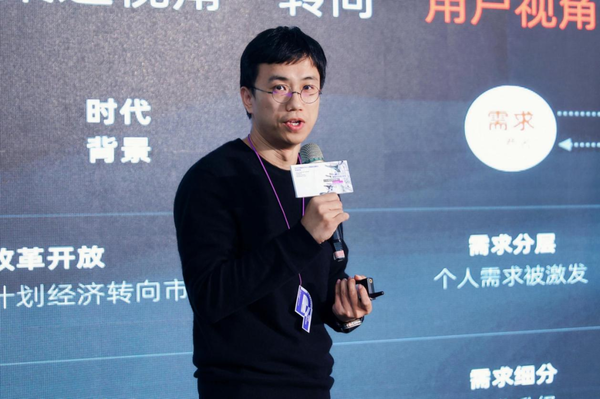
Alibaba International Digital Business Group - Middle Office Design& AIbusiness Design manager Jin Le

Zhou Hong mainly introduced the basic principles of behavioral analysis and a specific application example of behavioral analysis, which he plans to explore in the cross-innovation technology direction of medicine, industry and information technology.

Zhou Hong, Dean Professor and Ph.D. Supervisor of the Institute of Instruments, Zhejiang University

Chai Chunlei introduced the design engine developed by his team, which uses large amounts of data to help us clearly define design problems. By analyzing market data and user feedback, design goals can be precisely defined to ensure that the product is consistent with market needs. At the same time, it combines AIGC Perform design generation to create more competitive products and services through data, design engines, project cases, and AI-generated content. These methods help to better define design problems and gain insight into market trends.

Chai Chunlei, executive deputy director of the Future Design Laboratory of Zhejiang University and deputy director of the Modern Industrial Design Institute

Gao Ying shared from three aspects: the arrival of the digital survival era, the impact of digital art on the aesthetic experience of life, and the full-effect design practice of digital art.

Gao Ying, third-level professor, doctoral supervisor, and dean of the School of Art and Design at Zhejiang Gongshang University

Panxing introduced the Metaverse platform of Yuanyiji, which is committed to building new business scenarios of "visualization, digitization, and virtualization", to the Metaverse scenario approach, co-construction and sharing, the sharing of Yiji Metaverse business scenario applications, and the discussion of future ecology.

Pan Xing, Chairman of Yiji Holding Group

Roundtable meeting
The second roundtable was hosted by Wu Peiping, associate professor at the School of Industrial Design, China Academy of Art. He first asked Fan Liangzhong, deputy dean of the Industrial Research Institute of Ningbo Institute of Technology at Zhejiang University and general manager of Zhejiang Tianpai Technology Co., Ltd., what impact have digital interactions and intelligent systems had on the competitiveness and market position of enterprises? How do they help enterprises improve efficiency, innovation and sustainable development? Fan Liangzhong shared with everyone the industrial direction set by the school. First, as a university, it should transform the results and study a certain point of these studies in a more thorough and detailed manner. This is something that many companies do not have. Secondly, starting from the fact that the company is engaged in intelligent terminals, Metaverse and Ai The development of technology is just a process, and now we are at this stage to embrace it AI、 Embrace digitalization and combine it with learning, and enterprises need to combine it with new technologies. Secondly, I asked Luo Laibin, deputy general manager and general sales manager of Hualing Holding Group-Hangzhou Huihua Information Technology Co., Ltd.: How is technology changing consumer behavior and expectations now? What impact will this change have on industry marketing, customer relations, and back to product design and interaction design? Luo Laibin discussed digital interaction and the future development of the virtual world. He also said that regardless of changes in consumer behavior, he feels that the biggest impact is that our standard products will become fewer and fewer in the future, and non-standard and customized products will become more and more. Finally, Zeng Ping, a 2022 doctoral student in design at the China Academy of Art, shared some industries that improve design from a humanistic perspective, and proposed that the most important challenges facing the future are firstly embodiment and secondly digitality. At the same time, he said that the embodiment of Gome students can show this high ground precisely in this intelligent era, or a correct way to open digital interaction. The two cannot be biased. In fact, embodiment is the first.
poster design: Ding Yuxin, Fei Suer, Liu Yuqi, Liao Ruoyuan
Editor: Wang Xiaoxiao
Editor: Dai Junhao, Huang Shiming
Review: Wu Yichen
Submission email: SID@caa.edu.cn

